

New Washington Monthly Article Reveals a Nation Divided in Politics but United in Its Longing for Connection

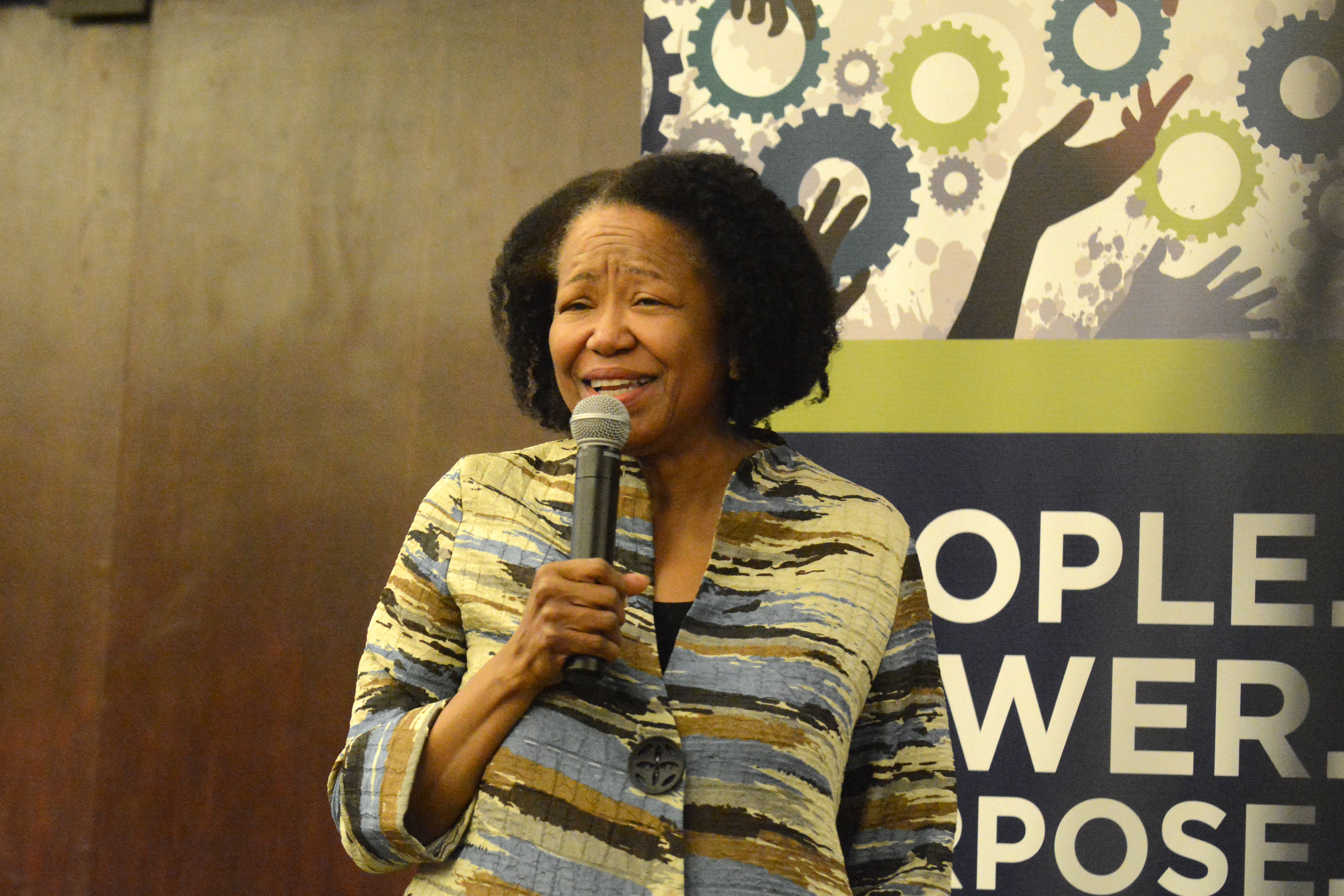
Dr. Gail C. Christopher
Dr. Gail C. Christopher proclaims that most Americans want to move beyond divisiveness to belonging, fairness, and less anxiety in their daily lives
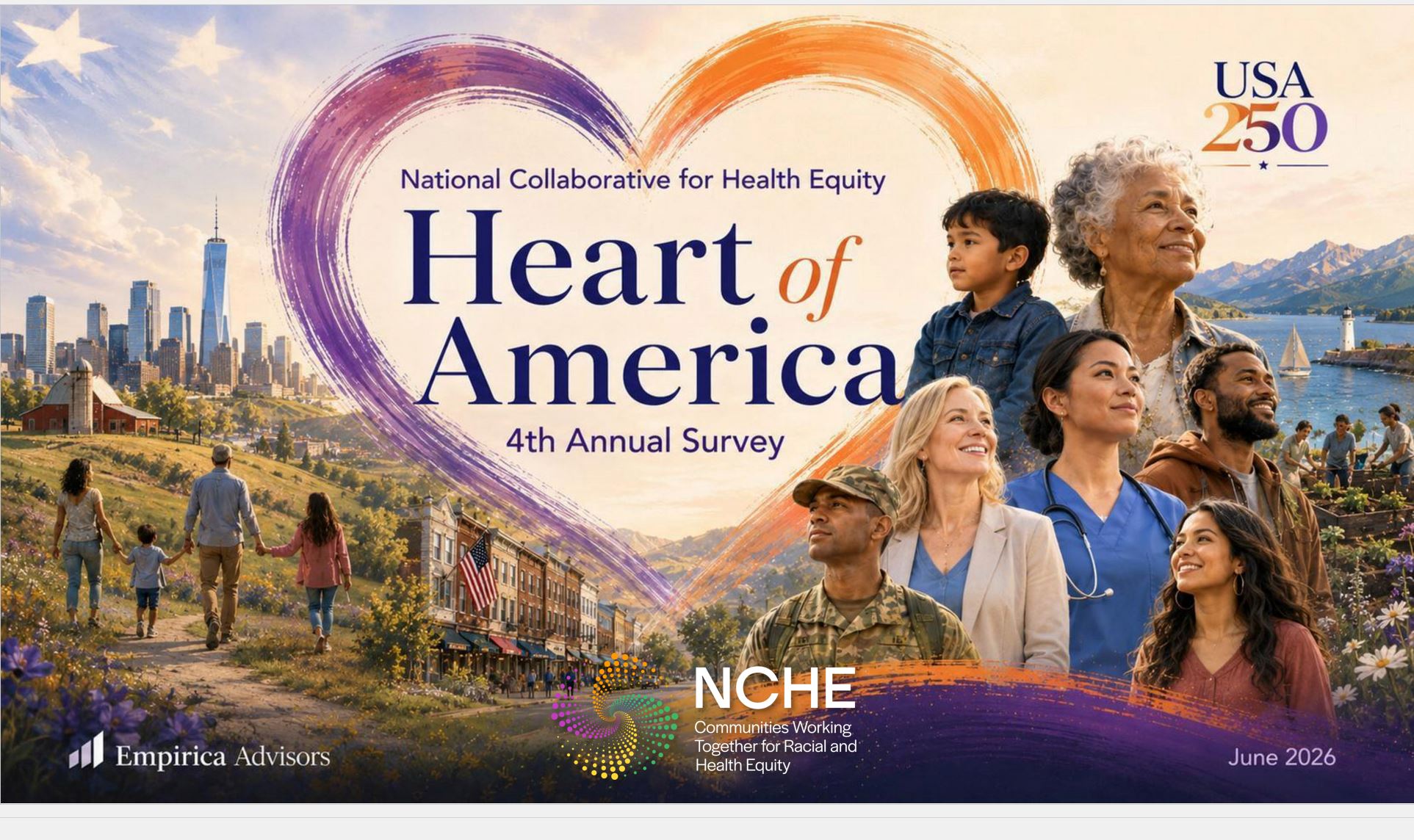
WASHINGTON, DC, UNITED STATES, July 22, 2026 /EINPresswire.com/ -- As the United States marks its 250th anniversary, a new article in Washington Monthly offers a striking counter-narrative to the story of a hopelessly divided America. In "The Heart of America Still Beats for Connection," Dr. Gail C. Christopher, Executive Director of the National Collaborative for Health Equity (NCHE), argues that the majority of Americans remain deeply committed to their founding ideals, even as they lose faith that those ideals are being delivered in their daily lives.
Drawing on the 4th Annual Heart of America Survey, a public opinion poll sponsored by NCHE, the article reveals a nation "holding two truths at once." "Americans remain deeply attached to the ideals this country was founded upon,” Dr. Christopher writes. “And Americans are increasingly worried that those ideals are not being delivered in their daily lives."
At the center of Dr. Christopher's analysis is what she calls "ambivalent patriotism": a loyalty to country paired with growing doubt about whether the country is honoring its promises.
The survey data tells the story. Sixty-two percent of Americans say they are proud to be American, still a majority, but a sharp drop from 72 percent just a year earlier. Meanwhile, only 36 percent believe the country is living up to its ideals of freedom, fairness, and equal opportunity.
"Two out of three Americans do not believe the nation is honoring its own creed," Dr. Christopher writes. "This is not the cynicism of people who have given up. It is the disappointment of a citizenry that still believes. You do not measure your country against its highest ideals unless you take those ideals seriously."
She defines this condition plainly: "attachment without satisfaction, loyalty without confidence."
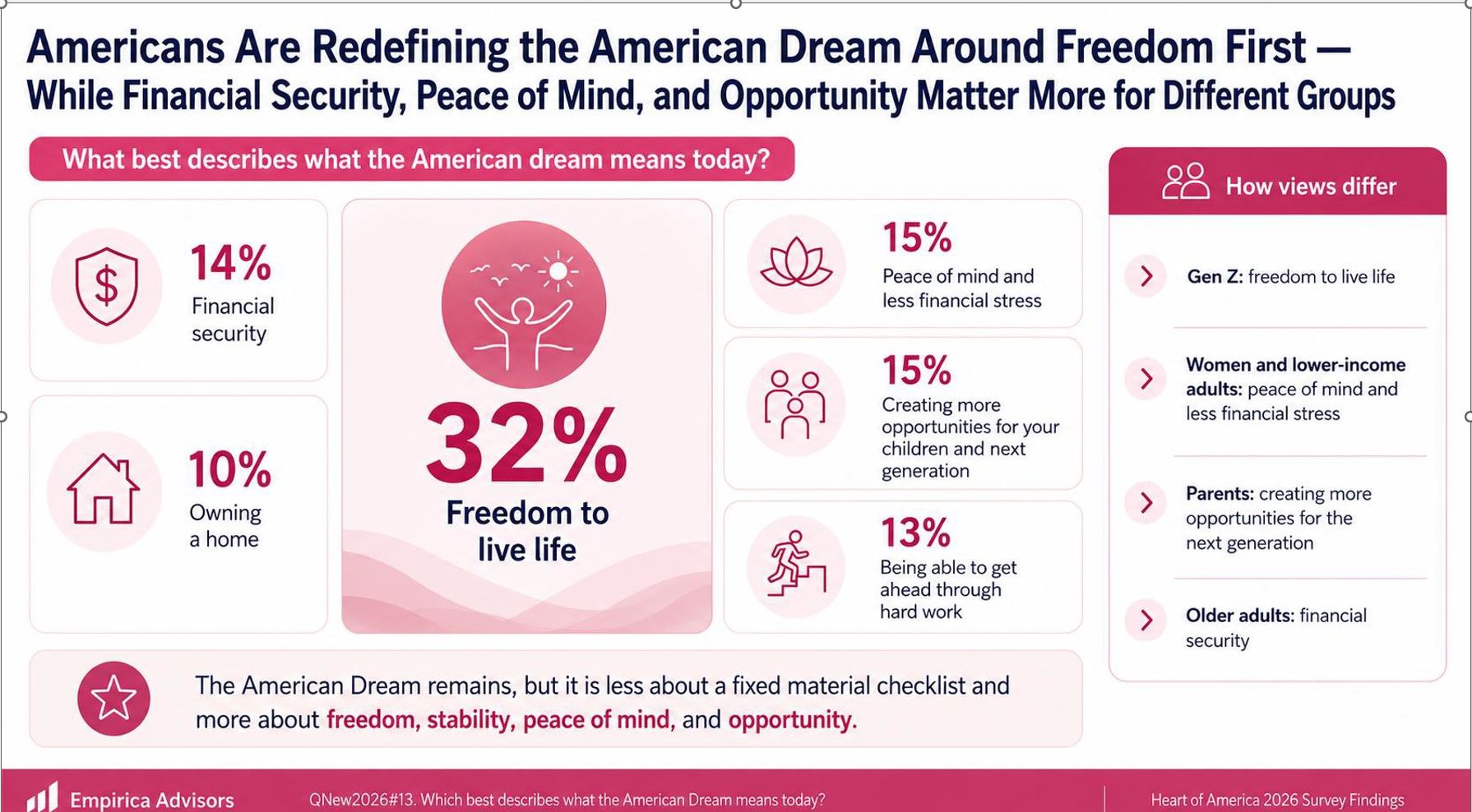
The article grounds this disillusionment in the everyday pressures that Americans face. According to the survey, 52 percent of Americans now say the American Dream is out of reach. The burdens they describe are immediate and tangible: 81 percent feel pressure from grocery costs, 75 percent from wages failing to keep pace with the cost of living, 72 percent from health care costs, and 71 percent from housing costs.
One finding signals a generational shift in family strain. Elder care, cited by 53 percent, has now surpassed childcare, at 44 percent, as a leading source of pressure on families.
For Dr. Christopher, these numbers point to a deeper truth about what the American Dream has always meant. "It has never really been about individual successes," she writes. "It is about whether families have the support to care for one another across the generations. Right now, too many families feel they do not."
Despite the strain, the survey's most hopeful finding is that Americans are not embracing division. They are reaching for something better.
The survey shows that 89 percent of Americans say the country needs leaders who are "transformers," people who can see through labels and political tricks to view the world in a new way. Eighty-three percent say they would support a leader who aims to unite everyone, even across disagreements. Eighty-four percent believe that through faith, kindness, and empathy, America can overcome its differences, and 71 percent remain hopeful that the country can find lasting common ground.
Most powerfully, 85 percent told researchers they believe Americans are hungry to belong, to connect, and to trust one another again.
"These are not the expressions of people who want to keep the fight brewing," Dr. Christopher writes. "These are people exhausted by conflict and hungry for connection."
She frames it as a quiet cry that has long gone unheard, writing, "Since the 1990s, the dominant narrative of our public life has been about polarization and division. But that narrative muzzles a quieter, more persistent cry: the genuine yearning of ordinary people to connect and to overcome what separates them. Our survey did more than notice that need. We measured it."
The article turns to a powerful cultural touchstone to illustrate the cost of division. Dr. Christopher points to The Hero Next Door, the new book by ABC News chief global affairs correspondent Martha Raddatz, which chronicles the experiences of soldiers who served in Iraq and Afghanistan.
These stories, Dr. Christopher writes, are "stark, humbling reminders of our common humanity." When you walk alongside these service members and their families, "something in you shifts. You stop seeing them through the lens of politics, region, or party. Instead, you are compelled to empathize, respect, and admire."
She connects their sacrifice to a warning about today's culture wars. "War is what happens when we fail to hear and address the persistent cries for unity, both within our nation and around the world," she writes, drawing a direct line between division and public health. "Continuous exposure to the culture war narrative generates chronic anxiety and fear. Anxiety and fear are directly linked to the escalation of chronic illnesses in the country. ... When we choose to amplify division, we are literally making our nation sick."
One of the article's boldest arguments asks readers to look honestly at what "culture wars" often conceal, including a false belief system that, from the 15th through the 20th century, "ranked human worth by race." The phrase "culture wars," she writes, "can serve as a convenient mask for that underlying ideology. It allows us to sidestep naming what is really at the heart of the conflict."
Yet she insists resistance to that false belief has always existed. Indigenous peoples, enslaved and free African Americans, Chinese and Mexican immigrants, and women "never accepted it." As she puts it, "There is an inner knowing, an innate awareness of our equal value as human beings. America, at its best, has always been the struggle to actualize this value and realize this nation's founding ideals."
For instance, Dr. Christopher cites Minneapolis, where residents "stood outside in sub-zero temperatures to protect and stand with their neighbors" during ICE-related violence against immigrant communities. "They refused to see the perceived other as other," she writes. "They saw a neighbor. That is the Heart of America at work."
The survey suggests this desire for repair runs far broader than political rhetoric. Eighty-two percent say promoting diversity in the workplace is important to racial healing, including 74 percent of Republicans, 79 percent of Independents, and 92 percent of Democrats. Eighty percent say reducing racial segregation in housing matters, and 92 percent support teaching the full history of America, including slavery and racism. Support for reparations has climbed to 56 percent, up from 46 percent in 2023.
"Americans are not just naming what divides them," Dr. Christopher writes. "They are naming the work required to become whole."
The article closes with a clear roadmap for building "the America we actually want." Dr. Christopher outlines four steps:
• Tell a truer story. "We must lift new narratives of our shared humanity," she writes, pointing to The Hero Next Door as one example among countless others waiting to be told.
• Educate honestly. For four straight years, more than 80 percent of Americans have said they want the true history of the country taught in schools, including protest, injustice, and progress alike.
• Demand transformational leadership. Americans are "yearning for wise, mature, and stable leaders" who address real anxieties about housing, health care, and wages, and who "lead with love rather than cruelty and see people, not labels."
• Make healing a cross-sector project. Education, public health, media, and technology all shape the stories we absorb and the conditions we live in.
"Healing must become our shared national project."
Dr. Christopher ends on a note of possibility, comparing this moment to earlier turning points such as Reconstruction, the founding of NATO, and treaties banning nuclear weapons, when extremes helped the nation see the need for something better.
"We can replace culture war with cultural peace," she writes. "We can replace the illusion of division with the reality that most Americans want civility, solidarity, and fairness. This is the work America's 250th anniversary calls us to begin."
Her closing words capture the heart of the piece: "The Heart of America beats for fairness and justice. Most of all, it beats for connection."
####
The full article is as: https://washingtonmonthly.com/2026/07/22/the-heart-of-america-still-beats-for-connection/
NCHE’S 4th Annual Heart of America Survey is a poll of 1,322 Americans age 18 or older conducted online from May 28 to June 3 by veteran pollster Shannon-Janean Currie, CEO of Empirica Advisors. It has a margin of error of +/-2.70. Full poll results are at https://www.nationalcollaborative.org/our-work/data-tools-resources/4th-annual-heart-of-america-national-survey-america-at-250/ All NCHE Heart of America surveys are archived at the Roper Center for Public Opinion Research ( https://ropercenter.cornell.edu/ ).
About Dr. Gail C. Christopher
Dr. Gail C. Christopher is the Executive Director of the National Collaborative for Health Equity, Senior Scholar at the Center for Advancement of Well-Being at George Mason University, and former Senior Advisor and Vice President of the W. K. Kellogg Foundation. Her latest book, RX-Racial Healing, is available now.
About the National Collaborative for Health Equity
Founded in 2014, NCHE was established to promote health equity through action, leadership, inclusion, and collaboration. We work to create environments that foster the best possible health outcomes for all populations, regardless of race, ethnicity, socioeconomic status, or nativity. NCHE also works to improve conditions for health and well-being, including housing, education, income and wealth, and the physical and social environment. Further, we must address historical and contemporary structural, institutional, and interpersonal racism, which fuels inequities in our society.
Michael K. Frisby
Frisby & Associates
+1 202-625-4328
email us here
Legal Disclaimer:
EIN Presswire provides this news content "as is" without warranty of any kind. We do not accept any responsibility or liability for the accuracy, content, images, videos, licenses, completeness, legality, or reliability of the information contained in this article. If you have any complaints or copyright issues related to this article, kindly contact the author above.
